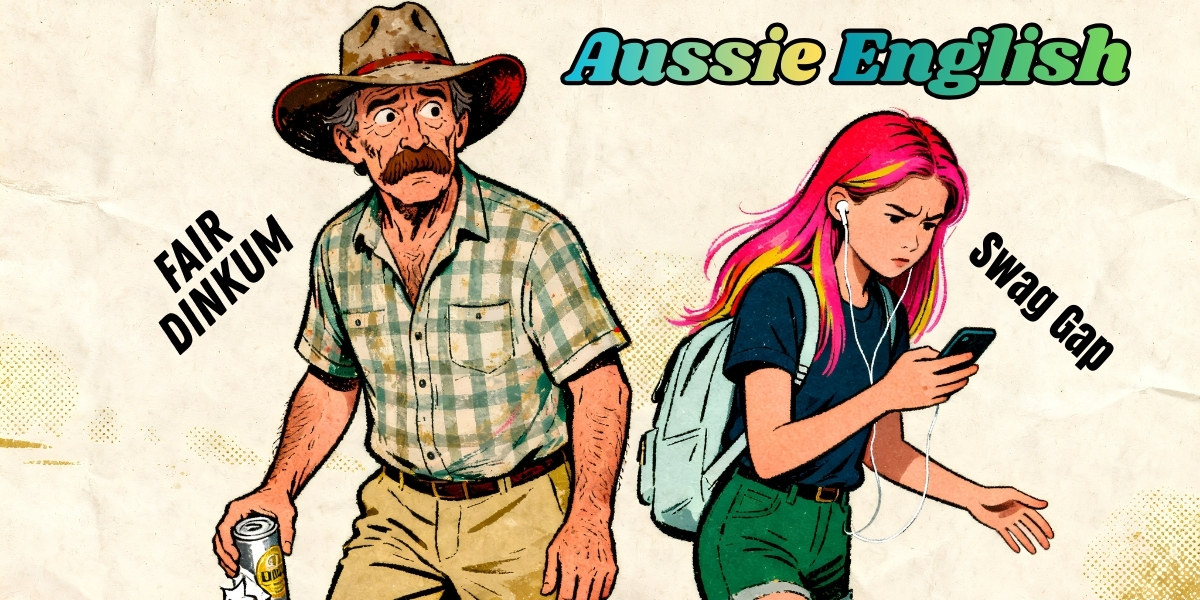
How our language has evolved over 20 years
Australian English has undergone a remarkable transformation over the past two decades. Expressions like “fair dinkum”, “she’ll be right” and heading to the “servo” in the “arvo” remain, but they now coexist with a fast-moving, internet-infused vernacular that can leave older generations baffled.
Less Ocker, More Online
Traditional Aussie slang (such as “fair dinkum”, “she’ll be right”, “servo” and “arvo”) is still alive. But younger speakers freely mix these with globally circulating internet slang, including “rizz”, “mid”, “bet”, “slay” and “cooked”, which no longer just describes your Sunday roast. The result is a fascinating hybrid, unmistakably Australian, yet unmistakably digital.

Irony, Memes and Moving Targets
Modern youth slang thrives on irony and layered meaning. Words rarely mean what they literally suggest. In 2005, slang could persist for years. In 2025, a phrase might go viral, peak in three weeks, become “cringe” and vanish entirely. Some expressions are intentionally absurd, a playful form of linguistic gatekeeping to keep older ears on their toes.

Enter the “Swag Gap”
“Swag Gap” exemplifies this trend. “Swag” conveys style or confidence, while “gap” highlights disparity. Put together, it signals a noticeable difference in coolness, a subtle reminder that, in the hierarchy of style, there are levels.
We once had “bogan”. Today, we have “Swag Gap”. She’ll be right, eventually.